
Bee season summery.
Well. My last post on this bee blog is almost a year old. A year ago I stated that I would do a better job keeping up with monthly blog posts. I guess not!!
.
 .
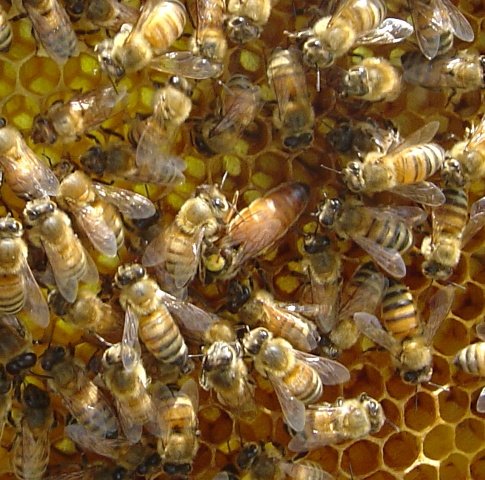
.Left: Beautiful pattern of brood layed by one of my queens.
.
.
.
.
.
.
.
.
The 2009 honey season, here on Cape Cod, was a complete bust. Our nectar flow on the Cape is in the spring. It rained so much this spring that the bees could not take advantage of the abundant nectar that was available. This resulted in very little honey being produced by the bees.
.
 .
.Left: Larva and Eggs ready to be grafted into plastic queen cups
.
.
.
.
.
.
.
.
.
A hive of bees needs about 50 pounds of honey to survive the winter here on Cape Cod. In an average season the bees will produce about 110 pounds of honey. 60 of that will be taken by the beekeeper, and 50 left for the bees for winter. The honey production was so poor this year that, in August, the bees had no honey in the hives and were in danger of starving. A couple of hives actually had no honey or nectar at all in the hive. Usually at this time there would be at least 60 pounds of extra honey in the hive in addition to the 20 to 30 pounds that would be stored near the brood or young bees.
Never in my 32 years of keeping bees have I ever seen a condition like this. I was forced to feed each hive of bees about a gallon of sugar syrup to sustain them. Fortunately it has been a good fall for the bees and we have been able to feed them substantially. The goldenrod has produced abundant pollen as for them as well. Even today bees were bringing in bright yellow packages of pollen to store for winter.
The verroa mite infestation has been the worst I’ve seen in years. This year I have gone back to treating the hives with chemical strips. The pesticide strips are designed to kill the mites but leave the bees alone. Thousands of mites are dropping out of the hives. Small hive beetle has been an issue as well. Fortunately not as bad as last year where I actually had bees leaving hives because they could not deal with the small hive beetle larva, which looks like groupings of small worms living in the combs.
.
 .
.Left: Queen larve foating in royal jelly. This larva was grafted into this cell 48 hours earler. The larva is 6 days old
.
.
.
.
.
.
.
.
.
The most disturbing incident however took place in March while I was installing two packages of bees we received from Georgia. Upon shaking the first package into an empty hive, I received a bee sting on my knee. As usual I brushed off my knee thinking that a bee just stung me from the outside of my pants leg. I finished installing the bees in the first hive and then continued to install the second package of bees in the second hive. Then I notice that my hands were burning. I thought to myself “That’s strange I don’t remember using these gloves for chemical or anything that would burn my hands”. I continued picking up and putting away my beekeeping equipment and noticed that my knee where I had been stung was still hurting… A lot. So I lifted up my pant leg and sure enough there was the stinger still in my knee pumping away. I removed it and noticed that one of my contact lenses felt strange. Then I started to itch all over. Sure enough… After keeping bees for 32 years, I now had developed an allergic reaction to the bee sting.
.
 .
.Left: Queen cells produced as part of my 2009 queen rearing project. This summer I raised 12 mated queens.
.
.
.
.
.
.
.
.
I got to take my first ride in an ambulance!