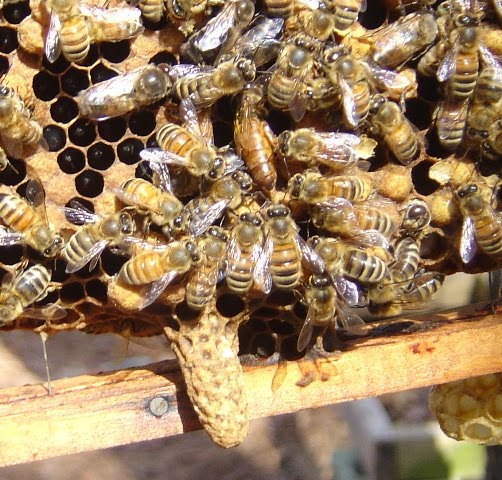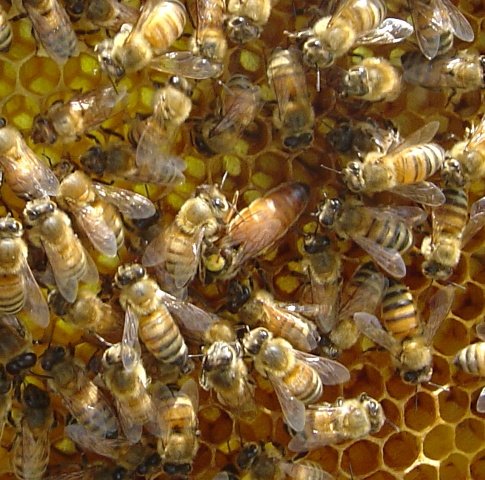
Showing posts with label Small Hive Beetle. Show all posts

November 27, 2011

Discouragement

Well it is the end of November already…..  And I have not written a blog post since May.  It’s not that I was lacking material to write about (the bees always provides that).  It’s just that by the middle of June I was discouraged with the progress of my efforts. 
Perhaps some of you may have better suggestions for me regarding my beekeeping efforts.

As you can probably tell from the post title, this year was another bad year for me and the bees.

In late winter we always hope for a productive year, but for the past three years the bees have not produced honey for us.

 Left:  Bees feeding on sugar candy and pollen patty


The season started slowly.  It was a rainy spring, and the spring lasted much longer than usual.

Spring actually arrived a few weeks early.  But the cold wet weather kept the bees inside the hives and not collecting honey and nectar.

Right:  Foraging worker bee


During the summer we had just the right about of sun and rain, no drought, plenty of flowers, plenty of work for the bees to do, but I could tell that the nectar flow was sporadic.

One day the bees would be flying like crazy, the next there would be very little activity.

As I look back on the season I cannot point to one thing that went  wrong.  It must have been a culmination of many factors.

My biggest problem this year was robbing.  I thought it would be smart to start the new colonies way across the property from the old ones.  The new location would offer more sun light during the winter months.


 Left:  Weak hive being fed sugar syrup from a division board feeder.  These feeders were robbed out by strong colonies nearby


This was an attempt on my part to decrease the winter losses by allowing the hives to warm up a little more on sunny winter days than the older hives have the darker old location (we’ll see how this works).  I also thought that by moving the new hives away from the older hives there would be less opportunity for robbing to start.

Well I was I ever wrong. 

The new hives which had a smaller population of bees were continually robbed out not only of any sugar syrup I was feeding them, but also of any stores of nectar that they were collecting themselves.  Without stores of honey and pollen the new colonies would not increase. 

I tried feeding the sugar syrup into the small hives first, then the larger hives….  I tried feeding  the sugar syrup into the larger hives first, waiting a day, then feeding syrup to the smaller hives.

I even resorted to building a feeding station away from the hives, that all the bees could access and get syrup.

Nothing I tried worked….  Yes the bees from all the hives would come and take 5 gallons of sugar syrup from the yard feeder in two days, but as soon as it ran out, the strong hives would return to robbing out the weaker hives.   

I also did not like feeding wasps, hornets, and yellow jackets with my precious public sugar syrup feeder.

So the fat hives got fatter, and the weak hives got weaker and died out.

Although the larger hives produced a surplus crop of 60 pounds of honey, I could not trust the honey since it was probably mixed with sugar syrup.

I fed all the honey back to the hives.

All this robbing was not conducive to increasing our hive numbers.  New packages, hive splits, and nucs brought on site from other locations were all destroyed by the robbing bees. 

Only three hives survived the summer and will be over wintered.

Then there was the small hive beetle……  I’ll talk about that next time.
And there's next year.....  There's always next year.

March 15, 2011

Middle Of March

It’s the middle of March and the snow drops are just starting to pop open here on Cape Cod.  Spring is just around the corner!

After enduring a long cold winter, mice, mites, small hive beetles, starvation, falling trees, and poor food stores, the bees are just now beginning to emerge from their winter cluster.


:Left:  Small Hive Beetle, dead on the sticky board.

          In March?  Realy?


The queen should have started raising young by now, and the new bees will be taking fights for the first time. How many of them emerge fly a little too far from the hive and become too chilled to make it back home?


Right:  Bees were finally able to take flight during warmer days here and there over the past couple of weeks.


We lost 50 percent of our hives to this long winter. We did not receive our January thaw as we do most years. Temperatures remained in the 30's for six weeks or more.  But then, I don't have to tell most of you that!

Of the remaining hives two are very weak. The Kona queens I introduced last year seam to be longing to return to the warm Hawaiian weather they came from.

They did not do well here.

Of course they have done better than the dead hives… That’s it… Look on the bright side!


Left:  My storage shed.... Filled with beekeeping equipment, boxes, frames.....  And mice!


One hive that started the winter with plenty of bees, frames of pollen, and frames full of honey was found dead a couple of weeks ago.

I had given them candy feed towards the end of January.

At that time they were robust…. 7 frames of bees. When I dissected the dead hive I found thousands of dead bees only two inches away from capped honey. There were still 6 frames of capped honey in the hive and three frames full of pollen. Why did they die? During the cold weather they probably just could not shift over to the food stores. What a shame!


Right:  The mice are so bold as to build nests in plain sight!


Sometimes you cannot figure out what went wrong. Is it natural selection? Or just a stupid beekeeper?

But yes…. As beekeepers often do, I spend a lot of my time during the winter thinking and dreaming about the bees. Perhaps answers come during those long months. I do have something up my sleeve… Perhaps I can do something about the weather!

The mice have been taunting me all winter as well. Despite my best attempts at thwarting them I continue to find chewed items around the storage shed. They love the newspaper wrapped wax foundation. An expensive item to snack on.


Right:  Outside temperature 34 degrees....  Inside temperature 60.

Perhaps I've found a way to control the weather!


One family even had the nerve to build a home right in plain sight, as if to dare me to try to do something about it!

But bright days are ahead! The weather is warming. The days are getting longer. The first flowers are poking there sleepy heads above the ground. The bees are starting to fly…

Yes the bees are starting to fly!

October 3, 2010

Board Bees Bad Bees

Well it is already October and the beekeeping season for 2010 is over.


Left:  Honey on the hives in July                                                    Right:  Same colony at the end of August

And I for one am glad to see it go.

A very early spring brought a very early end to the honey flow, which lengthened the amount of time that there was a lack of nectar and pollen this summer. It does not make a beekeeper happy to see his large, ready to collect hives, sitting with nothing to do.

Our nectar flow here on Cape Cod starts towards the end of June and ends the first week of August.

This year however it started two to three weeks early, and ended two to three weeks early. This resulted in a longer period of time between the spring and fall flows, (almost two months).

Left:  A colony started in spring never moved up into the upper hive body.  This colony has not produced enough stores to survive the winter.


This combined with late and poor goldenrod nectar flow resulted in starvation conditions for our hives. Hives with 50 to 60 pounds of honey on the hives in July were starving by the end of August.

Of course I am partly to blame for this. We had such good success building up colonies in the spring that there were many more mouths to feed when the nectar flow stopped early.

We have been feeding our hives sugar syrup and pollen substitute since the third week in August. Although the bees are doing well now, and there are plenty of stores in the hives because of the feedings, the additional sugar syrup and the length of time of the feeding has created other problems. namely, a large increase in the small hive beetle population in the hives. I haven't even mentioned the Varroa Mites!


Right:  Small hive beetle larva crawling out of the hives onto the bottom boards.  The feeding of sugar syrup for such an extended period caused an explosion in small hive beetle.  Varroa Mites can be seen on the bottom board as well.


Additionally our five new colonies never moved up into the upper hive bodies. Frames and new foundation were never drawn out or filled with stores for winter. This forced us to combine these weak colonies in order to ensure their survival. The queens of the weaker colonies were killed and their colonies were combined with other weak colonies.


Left:  Colony being prepaired for winter.  Crisco oil and sugar patty to fight Tracheal Mites, Pollen patty to provide polen when none is being collected, Menthal oil towel to fight Tracheal Mites, Small hive beetle trap, Apastan strips to fight Varroa Mites.  Sugar syrup is being fed with a division board feeder in a different hive body.


So, now that the hives are well fed, and in good shape to survive the cold, damp, cape cod winter, it is time to reflect on this past beekeeping season.

Hmmm… What would I, could I, have done different…… right now I just don’t know!

But I will have plenty of time to think about it over the next few months.

April 12, 2010

Do you really want to do this?

Last week I wrote about finding queen cells in one of my hives. April on Cape Cod is just too early for a hive to raise or replace a queen. The weather is unpredictable, the temperatures are low, and the few drones (males) around are probably not mature enough for mating.


Right:  Queen cell being produced by a hive that probably has a queen that is starting to fail.  If you look closely you can see capped worker brood and capped drone brood.  Can you find the queen?  She is there.


This hive’s desire to raise another queen could be for only one of two reasons.


Left:  A close up of the queen cell.  You can see the old queen just  above and to the right of the cell.  Around her are circled her attendant workers.  Perhaps the workers are guarding the new queen cell to keep it from being destroyed by the queen.  Or perhaps the queen knows she is being dethroned and is allowing it to happen!


Either they have been overcrowded and feel the need to reproduce (swarm), or the existing queen is failing and the bees have decided to replace her.
The weather was just good enough on Sunday (62 degrees) to make a hive inspection.


Guess what I found?

Sure enough the bees had built two more queen cells. I said "Do you really want to do this now?"


Right.  A queen larva, from one of the destroyed queen cells.


I found the old queen. She has been laying eggs, but upon closer examination I discovered that about 5% of the brood was drone brood scattered among the worker brood.

This is one of the signs that the queen may be failing.

A drone, (male bee), is produced from an unfertilized egg. Since queens only mate once in their life, (with up to 30 males), they store the semen within their bodies. When the queen starts to run out of semen she will lay more unfertilized eggs, which become males. Drones are larger than workers so their cells stick out beyond the surface of the comb.


Right:  One of my home made small hive beetle traps which is installed under the screened bottom board.  You can see all the dibris.  No mites and no small hive beetle.  There are beetles in the trap, but they are sap beetles.


This queen was introduced into this hive in 2007. That makes her three years old, going into her fourth season. I should have replaced her last fall, but she has been such a spectacular queen. She has out produced all my other hives. I have been using her eggs to produce other queens. I was hoping to stretch her through this last season.


Left:  Closeup of the trap and beetles.  The trap is baited with a mixture of mineral oil and cider vinegar.  I have had alot of sucess catching small hive beetles with this.


Since it takes 16 days to produce a queen from a fertilized egg, killing the queen cells has bought two weeks time. That is, as long as I did not miss one.


Right:  A closeup of the sap beetle.  They must be attacted to the cider vinegar.  These beetles are not a hive pest like the small hive beetle.


This season has defiantly gotten off to an interesting start.

March 8, 2010

If I knew then what I know now

This blog post will be an examination of my queen rearing attempts over the past three years with conclusions regarding correct and or incorrect processes.

My queen rearing project began out of a desire to see my bees survive the damp cape cod winters. I had been experiencing a 50% to 80% loss of colonies from year to year.

Left:  Example of bee larva of various ages.


I along with many beekeepers have noticed that over the past 30 years it has been harder and harder to keep bees. I have seen winter hive looses, not to mention summer hive losses, increase year after year.

I remember when I was 17 years old with my first hive of bees. They were Starline hybrid bees, and I knew next to nothing about keeping them. The hive survived for years on its own. Now that would seldom if ever happen. A hive that is not carefully kept and attended to will probably die the first season. Trachea, and Verroa mites along with the small hive beetle, as well new bee viruses, not to mention colony collapse disorder have devastated the bee population.

Right:  Queen Pupa of the development age from different size queen cells.  These queens were grafted on the same day.  Their developmental variation is probably due to the age of the larva at the time they were grafted.


In breeding and mass production of queens have weakened the genetic quality of our bees. Queens that would once last four or five years need to be replaced every two.


 Left:  A steady hand is needed to transfer the fragile larva from the comb into the artifical cell


 So what have I done about it? Well three years ago I started learning how to raise queens of my own. With both success and failure.

2007 (year 1). I experimented with two methods of queen rearing. The miller method, and the Doolittle method. I quickly became apparent to me that the Doolittle method allowed me much more control over the queen rearing process.

Right:  Larva after being grafted.  These larva should be only three days old.  Their various ages can bee seen by the degree of curviture of the larva.  Three day old larve look like a comma.  Some of these grafts appear to be 4 or 5 days old.  This would result in poor quality queens.


Positive

I learned how to graft (I was dry grafting at the time) larva into artificial cells.

I learned how to create a cell starter colony

I learned how to create a cell builder colony

I learned how to create queen mating nucs.

I was able to have 10% of my grafts accepted by the cell builder colony (9 out of 90 grafts)

Good size queen cells were created by the cell builder colony

I had 8 queens emerge

Queens were of adequate size.

I had 3 queens mate and start laying

 
Left:  Two days after grafting and being placed in a cell builder, you can see the larva floating in a pool of royal jelly.  You can also see how the nurse bees have started to add wax to the plastic cell as they start creating the queen cell.


Negative

Only 10% of my grafts were accepted

No queens survived into 2008


2008 (year2). I continued to experiment with the Doolittle method of queen rearing. I started to learn more about bee genetics and the importance of the Drone (male). I took a queen rearing class and discovered that if the artificial cells were primed with royal jelly, or even plain yogurt, better grafting results could be obtained.

Left:  My first queen cells from 2007.  You can see how large they are.  This is due to the proper age larve being grafted into the cell, and the fact that only 8 cells were accepted and fed by the nurse bees.  The cell builder colony was not over whelmed by the number of queen cells.


Positive

I raised queens three times that spring.

Wet grafting of larvae improved my acceptance rate to 90%

Grafting 90 cells yielded 80 queen cells.

I raised 15 mated queens that season.


Negative

Queen cell size was very small. This was partly due to my over whelming my cell builder hives with too many queen cells. I believe that I also grafted larva that was 4 or 5 days old not 3 as I should have. This resulted in smaller cells and smaller queens.

I had a problem creating nucs. I was not as organized as I should have been. I attempted to make splits from nearby colonies. 50% of the nucs created returned home to the mother hives abandoning the queen cells and brood placed in the nuc. The previous year I had used relocated bees to create the nucs. That method worked much better.

Right:  Queen cells from 2008.  You can see how small the cells are.  This was probably due to the number of grafts placed in the cell builder and the age of the grafted larva being too old.


I had problems with small hive beetle larva infesting two of the nucs creating a situation where the bees abandoned the nuc. This was probably due to the low numbers of bees remaining in the nucs thus creating stress within the nuc colony.

Queen quality was poor due to the small cell size. I did not attempt to over winter any of the queens.


2009 (year 3). I continued with the Doolittle method of queen rearing. It was an extremely cold wet spring. The colonies would not buildup and missed the main honey flow (May, June, and July). All the colonies were starving in August, a time where there should have been 60 pounds of surplus honey on each hive. Since there was no promise of honey that season two of the colonies were used for queen rearing.


Left:  Grafts from 2009.  Better cell size, but still too small.


Positive

I continued having great success with grafting and acceptance of the grafts. This improved to a 95% acceptance rate.

I learned how to create and use, with success, a queen right cell builder colony.

Grafted three cycles of queen cells over a two month period.

Raised 25 queens.

Learned how to bank queens.

One queen was overwintered and has survived.

 
Right:  More small queen cells


Negative:

Queen cells were small again. It became apparent that I was grafting larva that was too old. During one cycle, queens emerged two days before the expected age of 16 days old destroying 19 queen cells.

I had the same problems with creating mating nucs. Many queens were lost because the workers returned to the mother colonies.

I became allergic to bee stings


2010 (year 4). We will see, won’t we!


February 28, 2010

Flight at last!

Winters on Cape Cod offer little to brighten the spirit of a beekeeper. It is much too cold to look in on them and see how they are doing. We wait and wait until warmer days, days where the temperature edges above 40, to see any activity outside the colony.

.
Left: Hive open on a 45 degree February Day. You can see that much of the candy feed has been consumed by the bees over the last month.
.
.
.
.
.
.
Will my bees survive the winter cold? Has it been cold for too long? Are the bees starving in place because it has not been warm enough for them to relocate to fresh stores of honey?

.
Right: Another open colony. Not as much candy feed has been consumed.
.
.
.
.
.
.
.
.
After weeks of cold, the temperature finally pushed its way above 40 degrees, the bees broke cluster and commenced their cleansing flights. This gave me the opportunity to peak in under the cover to see how the bees were doing and whether or not candy needed to be added to help them survive the winter.


.
Left: Bees take to the air for a cleansing flight. Winter bees do not get out much!
.
.
.
.
.
.
.
.
.
Upon opening the hives it became apparent that the bees had consumed about half the candy I had placed in the hives in January. I was please to see that all of the hives were doing well. Most had 5 frames of bees, not bad for February. The queen should start laying eggs sometime within the next few weeks to start replenishing the workers lost over the winter.


.
Right: Close up of bees feeding on sugar candy. This candy supplements their stores of honey to help stretch their food for the long winter.
.
.
.
.
.
.


With this inspection I am hopeful that all the hives will survive this winter. Of course it is not the end of March yet. March is the month where the greatest bee loses occur. If their number s dwindle to low, the bees will not be able to keep themselves warm enough to survive. Many colonies die only a few weeks away from the bloom of first spring flowers.


.
Left: A bee and a hive beetle on a removed sticky board. The dead hive beetle was not there on the last inspection in January. Evidence that there are small hive beetles surviving the winter within the cluster of bees.
.
.
.
.
.
.
The bees in the hive now, are the bees which emerged last September, five months ago! They have not seen much other than the inside of the colony. They have spent much of their life keeping the colony warm, feeding on the stores of honey and pollen left there by their many sisters the summer before they were born.


.
Right: A worker bee rests on the edge of a brick, warming itself in the sun before flying back to the colony
.
.
.
.
.
.
.
.
Now begins the buildup of the colony in preparation for the honey flow in June and July. Starting in March we will begin feeding the colonies pollen, and sugar syrup to further stimulate their increase in numbers. We want the colonies strong in numbers for the honey flow. The more bees collecting pollen and nectar, the more honey will be produced.

March will tell…. March will tell…


Spring

Spring
Peach Pollen

Spring Pollen

Spring Pollen

Queen Cell

Queen Cell
Well Fed Queen Cell

Marked Queen

Marked Queen
Queen produced from my second graft attempt