Showing posts with label Miller Frame. Show all posts

June 23, 2007

The Mother Of All Queens Is MIA

Todays activities included grafting queen cells for the first time. I had intended to use eggs form the Mother Queen of my best hive. Upon opening the hive I could not find any eggs or larva. This is the hive I tipped over on June 8th when removing the miller frame from the hive. I thought that she was ok, Perhaps she was injured and died. There were no queen cells found in the hive. Perhaps I destroyed them during an inspection, not knowing that the queen was gone. On June 21 I examined the miller frame to find one large queen cell still intact. I moved this frame along with a frame of bees and brood to a queen mating nuc. The queen should emerge from the cell in a day or two. It will then take up to two weeks for the virgin queen to mate and start laying eggs.
.
.
Grafted plastic cell cups which have been pressed into the cell bar prior to grafting. Each bar holds 15 plastic cups.
.
.
.
.
.
.


I took a frame of eggs and larva from my next best hive. The hive has proven to be strong, but the bees are average in temperament and not as gentle as the mother queen I had hoped to use.
.
Cell bars with attached grafted plastic cell cups place in the cell bar frame. The frame is upside down, and will hang opposite in the cell builder hive.
.
See the frame of larva in the background?
.
Grafting is an interesting process.

The best queens are raised from larva that is newly hatched so I wanted to graft the smallest larva on the frame. The frame I selected from had everything from capped brood to eggs. With my reading glasses on it was easy to compare the sizes of the larva to make sure the youngest larva was selected. I used warm moist towels to keep the grafts warm and to keep them from drying out prior to transferring them into the cell building hive. After about 10 failures I was able to transfer the larva into the plastic cell cups. Since I created the cell building hive on June 1st it now contains, a few emerging brood, no eggs, no larva, and of course no queen. The only larva in the hive will be the young larva I grafted. If the bees accept the grafts they will begin to build queen cells from them. In 36 hours I should be able to see the results of the grafts.
.

.
The cell bar frame inserted into the queen cell builder hive. This hive has no queen, larva, or eggs other than what has been added with the cell cups.
.
.
I am hoping I will have more control of the process with the grafted cells verses the miller frame method used in prior weeks. There will be no question about the age of the larva and the expected emergence date of the queens. With the miller frame. eggs and larva of various ages could have been used by the bees to rear queens. Since the bees select which lava to turn into queens, there is less control. With the grafting method, since I was the one to select the larva, there should only be, at the most, 24 hours difference in the age of the queen cells.
.

From left to right. 10 frame cell builder hive, 4 section mating nuc, 4 section mating nuc. You can see the sugar syrup feeders. Only one of the mating nuc sections is in use. It contains a queen cell from the miller frame use peviously
.
36 hours will tell.


June 15, 2007

The Mother of All Queens (2)


.
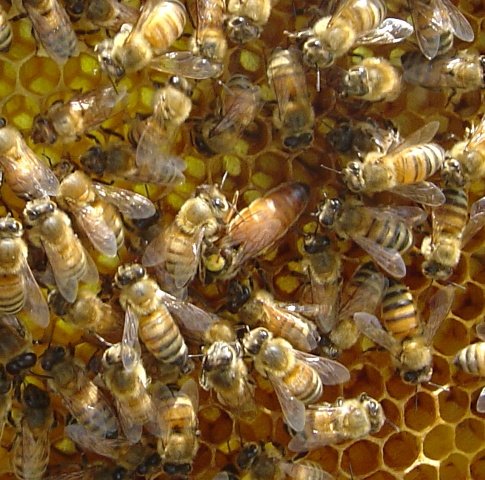
A bee with yellow June Pollen
.
.
.
.
.
.
.
.
.
.
.
.
.
.
.
The cold raw June Cape Cod weather finally broke today. It was partly sunny with temperatures in the low 70’s or high 60’s. It has been damp with rain on and off with the night temperatures the past four days falling into the 50’s, Not good weather for honey production. This has been a very difficult season for the bees already.
.
On June 10th there was a break in the weather before the temperature dropped. I took the opportunity to look at the Miller frame of eggs I had installed in the Cell Building Hive (see previous post). 48 hours had past. As you can see in the photo the bees had started drawing out 4 queen cells. I looked through the rest of the hive and removed queen cells from all other frames, about 4 cells.
.
The queen cells on the miller frame are being started from newly hatched eggs. Since the frame only had eggs on it, and not hatched young larva, the queen cells will be moved into queen mating nuc hives on June 19th or 20th.
.
The Miller frame on June 1st prior to it's insertion into the "Mother Queen" hive
.
.
.
.
.
.
.
.
.
.
.

Today (June 15) I had the opportunity to inspect the queen building hive again. I found about 12 good size queen cells on the miller frame.
.
After inspecting the rest of the hive, I removed 4 to 5 queen cells (capped and in the last stages ready to emerge) built on other frames. If I had waited another day or two all my efforts could have been defeated by these cells. It was obvious that there is plenty of royal jelly being produced in the hive. Royal jelly is essential for queen rearing since it is the only food the queens feed on.
.
.
.
The Miller Frame on June 10th. 48 hours after it was removed from the "Mother Queen" hive and inserted into the "Cell Builder" hive. The bees have started to build four queen cells.
.
.
.
.
.
.
The best queens will be raised on lots of royal jelly. These rival cells need to be destroyed in order to insure that they will not emerge and destroy the miller frame queen cells.
.
This miller frame is my controlled frame. I know the age of the eggs and I know which queen (hive properties and genetics) these eggs are from. Since I know the age of the miller frame, I can accurately calculate the date the queen will emerge from theses cells.
.
A queen takes 16 days to develop from egg to larva. Since these eggs were laid on June 7th or 8th, virgin queens will emerge from the queen cells on June 23rd (16th day from egg laying). Since 12 queen cells have been produced I will need 12 mating nucs to place the cells in (one cell per mating nuc) on day 14 (June 21st ).

I spent a few hours painting the mating nuc covers and bottom boards I built a few months ago. They will have to be stocked with bees (2 frames each) on day 13 (June 20th). Once the queens emerge from their cells they will take up to a week to mate and start laying eggs. There is only a 75% success rate in the mating of queens. I have lots of drones (male bees) in my other hives, and I know the beekeeper who has bees less than a mile away from me. There should be plenty of drones in the area for the queens to mate with.
.
It will be interesting to see what happens over the next few weeks. At this point I am happy with the success of my first effort. Once the daytime temperature reaches 75 to 80 degrees, I am planning to try my hand at grafting queen cells. We will talk about that when the time comes.
.
The Miller Frame 7 days after being inserted into the "Cell Builder" hive. There are 7 queen cells on this side of the frame, and 5 queen cells on the other side.
.
.
.
.
.
.
.
.
.
Now an update on honey production. My three strong hives, including the mother queen hive, are starting to store nectar in the honey supers. Two of the hives are now producing round comb honey, one hive is producing liquid honey. Of the other hives, one has been struggling all spring. They are still only on 5 frames in the bottom box of the hive, compared to my best hive which has 24 frames of bees, produced the miller frame of eggs, and donated 6 frames of bees to the queen rearing project.

Not to mention the fact that it was knocked over by me during and inspection!.
.
.
A queen cell produce under uncontrolled conditions.
.
.
.
.
.
.
.
.
.
.
.
.
.
.
.
I will be inspecting the hives for swarming preparation this weekend.
.
I will post more results next week.


Spring

Spring
Peach Pollen

Spring Pollen

Spring Pollen

Queen Cell

Queen Cell
Well Fed Queen Cell

Marked Queen

Marked Queen
Queen produced from my second graft attempt