
Well it is the end of November already….. And I have not written a blog post since May. It’s not that I was lacking material to write about (the bees always provides that). It’s just that by the middle of June I was discouraged with the progress of my efforts.
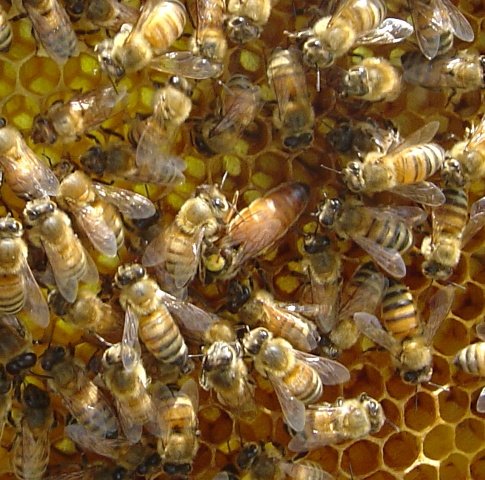
 Left: Bees feeding on sugar candy and pollen patty
The season started slowly. It was a rainy spring, and the spring lasted much longer than usual.
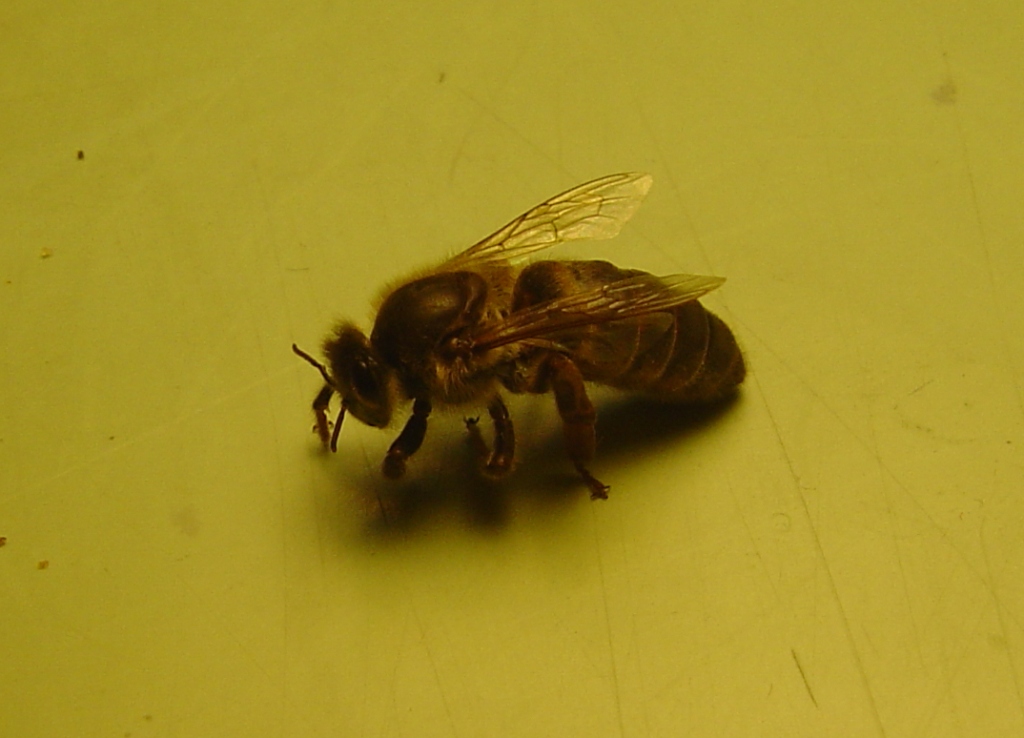
 Right: Foraging worker bee
During the summer we had just the right about of sun and rain, no drought, plenty of flowers, plenty of work for the bees to do, but I could tell that the nectar flow was sporadic.

This was an attempt on my part to decrease the winter losses by allowing the hives to warm up a little more on sunny winter days than the older hives have the darker old location (we’ll see how this works). I also thought that by moving the new hives away from the older hives there would be less opportunity for robbing to start.
Nothing I tried worked…. Yes the bees from all the hives would come and take 5 gallons of sugar syrup from the yard feeder in two days, but as soon as it ran out, the strong hives would return to robbing out the weaker hives.
Although the larger hives produced a surplus crop of 60 pounds of honey, I could not trust the honey since it was probably mixed with sugar syrup.
I fed all the honey back to the hives.
All this robbing was not conducive to increasing our hive numbers. New packages, hive splits, and nucs brought on site from other locations were all destroyed by the robbing bees.
Only three hives survived the summer and will be over wintered.
Perhaps some of you may have better suggestions for me regarding my beekeeping efforts.
As you can probably tell from the post title, this year was another bad year for me and the bees.
In late winter we always hope for a productive year, but for the past three years the bees have not produced honey for us.

The season started slowly. It was a rainy spring, and the spring lasted much longer than usual.
Spring actually arrived a few weeks early. But the cold wet weather kept the bees inside the hives and not collecting honey and nectar.

During the summer we had just the right about of sun and rain, no drought, plenty of flowers, plenty of work for the bees to do, but I could tell that the nectar flow was sporadic.
One day the bees would be flying like crazy, the next there would be very little activity.
As I look back on the season I cannot point to one thing that went wrong. It must have been a culmination of many factors.
My biggest problem this year was robbing. I thought it would be smart to start the new colonies way across the property from the old ones. The new location would offer more sun light during the winter months.

Left: Weak hive being fed sugar syrup from a division board feeder. These feeders were robbed out by strong colonies nearby
This was an attempt on my part to decrease the winter losses by allowing the hives to warm up a little more on sunny winter days than the older hives have the darker old location (we’ll see how this works). I also thought that by moving the new hives away from the older hives there would be less opportunity for robbing to start.
Well I was I ever wrong.
The new hives which had a smaller population of bees were continually robbed out not only of any sugar syrup I was feeding them, but also of any stores of nectar that they were collecting themselves. Without stores of honey and pollen the new colonies would not increase.
I tried feeding the sugar syrup into the small hives first, then the larger hives…. I tried feeding the sugar syrup into the larger hives first, waiting a day, then feeding syrup to the smaller hives.
I even resorted to building a feeding station away from the hives, that all the bees could access and get syrup.
Nothing I tried worked…. Yes the bees from all the hives would come and take 5 gallons of sugar syrup from the yard feeder in two days, but as soon as it ran out, the strong hives would return to robbing out the weaker hives.
I also did not like feeding wasps, hornets, and yellow jackets with my precious public sugar syrup feeder.
So the fat hives got fatter, and the weak hives got weaker and died out.
Although the larger hives produced a surplus crop of 60 pounds of honey, I could not trust the honey since it was probably mixed with sugar syrup.
I fed all the honey back to the hives.
All this robbing was not conducive to increasing our hive numbers. New packages, hive splits, and nucs brought on site from other locations were all destroyed by the robbing bees.
Only three hives survived the summer and will be over wintered.
Then there was the small hive beetle…… I’ll talk about that next time.
And there's next year..... There's always next year.