Showing posts with label Virgin Queen. Show all posts

May 30, 2011

May Bee

The long holiday weekend finds me posting my first blog post for the month of May.


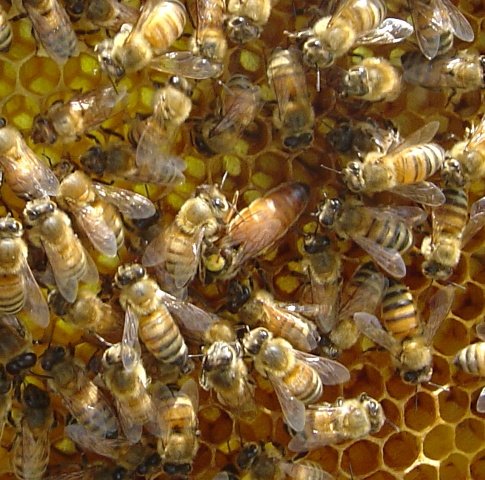
Left:  A worker bee collecting pollen and nectar from our peach tree.


For some reason we have experienced a 90% loss of our over wintered hives this season.

Two hive have died in the month of April alone. Not usual once they make it through March

The longer than average, and cooler, spring has not helped us much. We experienced cool rainy wet weather for almost two weeks in the middle of May, not conducive for brood rearing by already weakened hives.

Last week however, the cold wet weather broke, and we are now experiencing warmer days. That means happy days for the bees who are now able to fly and collect the much needed nectar and pollen for the spring buildup.

Today I started rearing a small number of queens.


Right.  Newly grafted plastic cell cups.  These cells were wet grafted using royal jelly saved from queenrearing in 2010.


It takes 16 days for a queen to grow under the proper conditions. I took newly hatched eggs from three of my hives and wet grafted them into artificial cell cups. Wet grafting is the process of placing a small drop of royal jelly in the bottom of each artificial cell cup, and floating a young larva onto it. (a 50 / 50 mix of plain yogurt and water will do as well for a priming medium)

Eggs from the different hives were grafted into different color cell cups. Red, yellow, and black cups were used. This will allow me to tell which hive the larva was grafted from later on.

The cells were placed into a cell bar and installed in a cell starter hive.

I create my cell starter hives by taking a 5 frame nuc box with a division board feeder half full of sugar syrup, add a frame of nectar and a frame of pollen.

I have modified the nuc box so it has a screened bottom. The entrance is closed so the bees will not be able to leave.

Before I graft the artificial cells, I shake nurse bees (from frames of open brood) into the 5 frame nuc box. I use at least three frames of nurse bees, and two frames of bees from adjoining frames. Of course before I do all this I find the queen, in the contributing hive, and make sure she is not shaken into the cell starter hive!

I took my grafted cell bar frame and installed it in between the pollen and nectar frames.

The trapped nurse bees will have nothing to do but feed the young larva. Because the cell starter is queenless they will build queen cells out of the young larva.

I will wait 24 hours and check to see how many of the grafts were accepted.

Our package bees were delayed from the supplier down south. Many orders were canceled. They must have been having a difficult time there as well.

Last week we finally received our new bees. They had a long trip from Florida, traveling by night, the truck would stop for the day to allow the bees to fly. It took several days to make the trip, and the trailer of bees arrived late one night. About 20 volunteers enjoyed unloading them off the trailer.

We must have been quite the site to the neighbors….. a mass of beekeepers with flashlights (and head lamps) scurrying round a dirt road, walking to and forth, unloading over 200 packages of bees. I know I received at least one strange look from passer buy on the main road. What are you doing walking at the side of the road in a full bee suite? They must have said!

That being said I brought my bees home and installed them the next morning. They were not happy to see me….. I guess they were grumpy from they’re long trip. Several met me with the message I should leave them alone. But…. Then… You have to show them who’s boss! (bees don’t listen well)
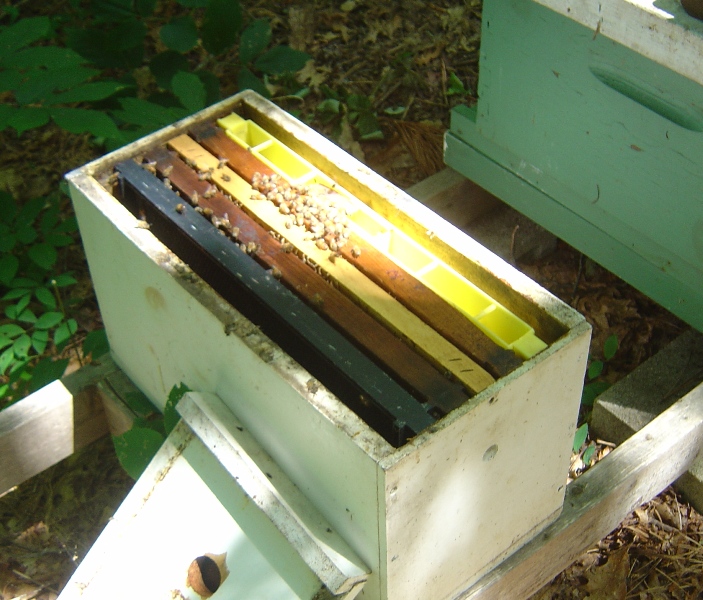

Left:  A cell starter colony mad up of a division board feeder, a frame of pollen, grafted cells, a frame of open nectar, an undrawn frame, and nurse bees.


The first nucleus of bees was installed without event. Five full frames of bees, honey, and brood were installed on previously drawn out comb. They were very active, fliying the next day in the warm sun.

I noticed that the second nucleus of bees had a recently emerged queen cell, capped brood, but no eggs or larva…. I did see a queen though.


Right:  A well feed queen larva.  The nurse bees have added royal jelly to the cell.  The larva floats on the royal jelly and eats it as it grows.  It will take 16 days for the queen to grow from an egg to a fully developed virgin queen.


She must have emerged during the long trip from Florida… But had she mated? Or was she still a virgin, unable to lay worker eggs? I would have to wait to see.

Two days later I checked the hive…. No eggs or brood…. But the queen was still there. Perhaps I would have to replace her with a laying queen…. If one could be found this time of year…..

Two days after that I checked the hive again…. Yes, there were new eggs laid in many cells. I guess this queen might just be fine. Perhaps she had mated during the trip north, while the truck was stopped in another state, and had managed to find her way back to the truck before it continued on.

Perhaps she has a little Pennsylvania or Georgia influence in her now! If you know what I mean!

Maybe she will be just fine…..


Maybee

June 29, 2010

Queen Cells and Counting

In my previous post I described the steps I am taking this year with my queen rearing project.

As of my last post I had managed to get queen cells into cell builder colonies.

Above:  18 queen cells being removed from a queen-right cell builder colony. 
Some of these cells will be placed into queen-less mating nucs

Sunday afternoon I moved the queen cells from the cell builder hives into individual queen-less mating nucs. Usually I move the queen cells on day 14 (10 days after grafting, and two days before emergence on day 16) to the individual nucs.

Above:  As an experiment I kept 3 of the cells in the queen-less cell starter colony. 
As you can see I ended up with larger cells.

I moved them a day early (day 13) this year, because, last year I had 16 cells destroyed when one of the cells emerged early.

Step 7 Continued:
Ok, So at this point I had 21 cells, 18 in a queen right cell builder colony, as I described last week. On the 14th day (10 days from grafting, and two days before the queens emerge) the cells should be individually placed each into its own queen-less mating nuc.


Left:  By adding a frame of brood to the queen-less cell starter colony, I converted it into a queen-less cell builder colony that built larger cells.


Most of my mating nucs are regular deep hive bodies that I have divided into four compartments, each with its own separate entrance. Each compartment will hold two frames. Each compartment has a cover and a sugar syrup feeder.

To make up the nucs I take frames of bees and open larva from my hives and place them into the nucs. The nurse bees will stay with the brood to take care of it.


Above Left:  Cells from the queen-right cell builder.  Right: Cells from the queen-less cell starter.


\I place one frame of bees and brood, and one undrawn frame into each compartment. I then introduce a queen cell (with cell protectors) into each nuc.

You can see that it takes a lot of bees to raise queens. If you have 10 queen cells you need 10 mating nucs. If you have 50 queen cells you will need 50 mating nucs.

Above: One of the cells from the queen-less cell starter, converted to a cell bulder. 
You can see that there is still alot of royal jelly in the cell.


Step 8: Wait and allow the queens to emerge. Each queen will emerge on day 16 (10 days from grafting) into a nuc.

This nuc will become a little colony.

The bees will take care of the new virgin queen. In about a week she will take mating flights and mate with up to 35 drones (male bees). She will fly back to the hive, and if successful will start laying eggs in about another 7 days.


Above:  Cells from the queen-right cell builder
You can see there is no royal jelly in the cell.
Did the workers rob the royal jelly to feed to worker larva in the queen-right colony?
All the cells came from the same cell starter.  All the cells were over filled with royal jelly before they were placed in the cell builder colonies.  There is a difference!

This year I did not move all the cells into the queen-right cell builder. I left three cells in the queen-less cell starter colony. By adding a frame of emerging brood (no eggs or larva) to the cell starter I converted it into a cell builder colony. It was interesting to see that the queen-less cell starter colony built much larger cells than the queen-right cell builder colony.

It is obvious that the large number of nurse bees in the queen-less cell starter colony made a big difference in the quality of the cells. I expect I will get larger queens from the larger cells. In the future I plan to abandon the use of the queen-right cell builder in favor of a queen-less cell builder assembled specifically to build cells.


Right:  Red plastic cells and yellow plastic cells each contain larva grafted from different queens.  The cell color tells me which queen mother the cell is from.


Additionally I took eight of the cells and arranged them so the virgin queens will emerge into queen cages. These cages have been placed into a queen-less, brood-less hive. It is my hope that the workers will care for the emerged virgin queens.

I have plans for these eight virgins I may share with you at a later date.

Tomorrow 21 queens will be emerging. This weekend I will look in on them to see how the new queens are doing.

I’ll let you know.

June 23, 2010

Queen Season

Father’s Day. A holiday to commemorate all the hard working fathers. The perfect time of year to raise queens.

Generally, on Cape Cod, at this time of year, a colony will have built itself up to about 30,000 or 40,000 bees. Over the next month they will continue to increase in numbers to about 60,000. As the bees start to get crowded they start thinking about swarming.


Above:  Queen cup frame just pulled from my cell starter hive. 
After 36 hours the bees have started building queen cells. 
You can tell the accepted cells by the wax that has been added to the cell.
24 cells have been accepted out of 28 grafted cells

Swarming involves building queen cells. A beekeeper can use this natural tendency of the bees to raise his own queens.

It is always easier to work with the bees rather than against them.


Above:  Close up of the started cells

Here’s what I have been doing.

Step one.

Create a cell starter hive. Take a strong colony and locate the queen. Place her and the frame she is on aside. Now take all the frames that have open larva and shake the bees into a 5 frame nuc (at least 5 frames worth of nurse bees). What you are doing is shaking nurse bees into this nuc since they would be found on the frames with open larva. There can be no queen or they will reject the cells you put in the nuc later. That is why we located her and put her aside. To this nuc add one frame of pollen, one frame of nectar, and a wet sponge. The bottom of the nuc should be screened so the bees will not over heat. The entrance must be closed so the bees cannot return to their original colony. Put the cover on the nuc for now.


Above:  A well fed queen cell which is 36 hours old
You can see how the larva has grown in a day and a half!

Step Two

Choose the hive (queen mother) you plan to raise queens from. You will need her eggs! Of course you will select the strongest, best behaved, active, honey collecting colony you have to pick from. Locate the queen and put her aside. Also locate a frame of eggs and young larva (newly hatched) and brush all the bees off of it back into the colony you are taking it from. If you shake the frame you will also move the larva from the center of the cell it is in.

Step Three

Graft newly hatched larva, 3 days old, into primed plastic queen cell cups. I prime the cells with royal jelly I saved (froze) from the previous year. You will also have success if you prime the cells with a mixture of 50% plain yogurt and 50% water. Just a small drop in the center of each plastic cell will help you float the larva off the grafting tool. The larva should look like a comma. If it looks like a full C shape the larva is too old. Use the youngest larva you can find. Use a damp hand towel to cover the grafted cells so they do not dry out. Graft two bars of 14 cells each, that will be 28 cells all together.

Step Four

Place the queen cup frame into the cell starter hive you created earlier. Place the grafts between the two frames, pollen frame to one side, open nectar frame to the other. Now leave them alone for 24 to 48 hours. Place the frame of larva you took the grafts from, back into the hive you stole it from.


Above:  Same cell with wax removed.  See all the white
royal jelley in the cell?  I will harvest this and freeze it
for use next queen season


Step 5

Prepare a queen right cell builder hive. Open the hive and find the queen. Place her in the bottom hive super with all the empty and capped frames of brood. Place a queen excluder over the box with the queen and put all the open larva, pollen, and nectar in the box. Leave an open space between open larva and a frame of pollen to place your started cells. Leave this colony over night while your cells are in the cell starter hive. This will allow time for all the nurse bees in that colony to move to the upper box. It will be 3 days before any eggs the queen lays in the lower box to hatch and require nurse bees.

Step 6

After 24 to 48 hours open the cell starter hive and remove your grafts. You will be able to tell which cells have been accepted by the bees by the work they have started on the cell. Excepted cells will have wax being added to them. This year the bees started 24 cells out of 28 grafts. Not bad. Take the queen cell frame and place it into the cell builder hive you prepared the day before. This hive will feed and build the cells.


Above:  Just a side note.  I was pleased with the very
large crop of peas we produced in the garden this year.
Thanks polinators!

Step 7

Wait and count. It takes 16 days for a queen bee to be created. Remember that the larva you grafted is already 3 or 4 days old. The queens will hatch at 16 days old, only twelve days after you graft them. Before that happens you will need to move the individual cells into queen-less mating nucs, or a queen-banking hive.


More on that next time.......

May 7, 2010

Hawaiian Queens

Update:  We are now on Facebook at:

http://www.facebook.com/group.php?gid=112000928841858&v=app_2373072738#!/group.php?gid=112000928841858&v=wall

Come Visit!


Last night I was informed that a fellow beekeeper had just received a shipment of queens from Hawaii.

With a quick call, and short driver over to the next town, I had two beautiful Kona Queens.


Above:  Two Kona Queens From Hawaii.  The blue mark indicates they are 2010 queens


Since they did not have any attendant workers in the cages with them I needed to get them into colonies as soon as possible. From what I have heard from fellow beekeepers the Kona queens have done well here on Cape Cod.

Last week’s inspections revealed that one of the hives was queen-less, while another had dwindled down to about one hundred bees.


Right:  a few of our colonies.  You can see the two white 5 frame nucs, just created, in the center bottom of the photo.  One of these nucs contains the old queen discovered during the hive inspection.  The other contains bees, eggs, and larva.  They will have to raise their own queen.


As you may remember the queen-less hive is our "nasty" hive, and being queen-less did not help their attitude much. As I opened the colony I had flashbacks of the previous week’s events, and wondered if that nasty little worker bee was still waiting for me inside.

As I looked over the frames I could see that they were attempting to build queen cells, but had nothing to put in them since the hive had no queen, larva, brood or eggs. I found three empty queen cell starts.


Left:  The hives are still working the dandilions.


As soon as I placed the queen and her cage on top of the frames the worker bees were all over her. I plan on letting them get to know her for a few days before I remove the cork protecting the candy in the cage. Once I remove the cork the workers will eat through the candy in a day or two and release her. I want to revisit this hive to verify that there is no laying worker before I take the chance and allow them to release her. This will provide a few additional days to help in acceptance.

Perhaps, with a new queen, this hive will settle down a bit. If the workers accept the queen she will begin to lay eggs, and the entire genetics of the colony will change over the course of two months making this hive more gentile.

I opened up the dwindling hive to look at them. Sure enough they had killed the failing queen, and in her place built five queen cells!


Right:  Workers gather water for the colonies.


I destroyed the queen cells and place one of the new queens on the top bars in the colony. I will check again in about 5 days to make sure the workers have released her.

While I was out in the apiary I thought I should look in on the hive that superseded the queen from 2007. I opened the hive to find it full of eggs and young larva! The new queen is doing fine.

Guess what else I found! Sure enough, there in the top box, was the old queen, with her faded yellow marking and all!. I put her aside in a nuc box with an additional frame of bees and brood, and continued to look for the new queen. I found her in the bottom box with eggs and young larva! She has filled out since mating and is a good size.

This is the first time I have seen this. Mother and daughter queens existing in the same hive.

They have been coexisting for at least two weeks if not longer.

What a surprise!

I never know what I am going to find next!

April 25, 2010

You Thought You Could Stop Us

It has been 19 days since I destroyed queen cells in one of our hives. I believe the old queen was failing and the bees decided that, what was best for the hive, would be to replace her.

Right:  Emerged queen cell.  A new queen has emerged from this cell within the past week.  Worker bees are in the process of demolishing the cell.  A new queen cell can be seen to the left of the emerged cell.  A worker in inside the cell tending to the queen larva.


Last week I found that the bees had built more queen cells and I decided to let them replace the old queen.

I have been concerned that it is too early in the spring for mature drones to be available for mating.


Left:  The new queen.  Can you find her?  I expected to find a virgin queen since it usually takes two weeks for a queen to mate and start to lay eggs.  I found new eggs everywhere in the hive.  I beleive she is laying


Sure enough, upon inspection, I found that one of the queen cells had emerged. The empty cell was in the process of being destroyed by the workers. I estimate that the new queen emerged a few days earlier.

I searched to find the virgin queen. Sure enough I found her, but I also found eggs…. Lots and lots of eggs. I guess she is not a virgin any more.


Right:  Enlarged area of photo above showing closeup of the new queen.  I am concerned that she is small.  Queen ususally enlongate after mating.  I will check her in a week to see how she is doing.


Could this queen have mated and started laying in less than a week? My experience has been that a queen will take up to two weeks after emergence to mate and start to lay. This queen seems to have done it in less than a week.

I am concerned that she seems a little on the small side. If the bees are happy with her I will let her stay until a better queen is available later this spring.

I am now kicking myself for destroying the beautiful large queen cell that was built at the beginning of the month. Sometimes I need to just let the bees be bees. They know their business better than I do.


Left:  A worker bee bringing pollen into the hive with the new queen.  With new eggs there will be young larva to feed in a few days.


On the other hand however, I have been watching one of my hives dwindle down in size. There is no sign of disease. The queen was very successful last season and the hive was strong all winter. Now they will not survive another week. Why… I don’t know.


The question for a beekeeper always is, When to I let nature take its course, and when do I intervene.


Spring

Spring
Peach Pollen

Spring Pollen

Spring Pollen

Queen Cell

Queen Cell
Well Fed Queen Cell

Marked Queen

Marked Queen
Queen produced from my second graft attempt